In modern engineering teams, a slow download or deployment step can stall dozens of developers at once. When your pipeline depends on the 8tshare6a software download stage, designing for high throughput is not optional—it’s foundational to reliability, developer productivity, and release velocity.
Below, we’ll walk through how to integrate 8tshare6a into a production-grade, high-throughput CI deployment workflow that stays fast even as your team and codebase scale.
Understanding 8tshare6a in a CI context
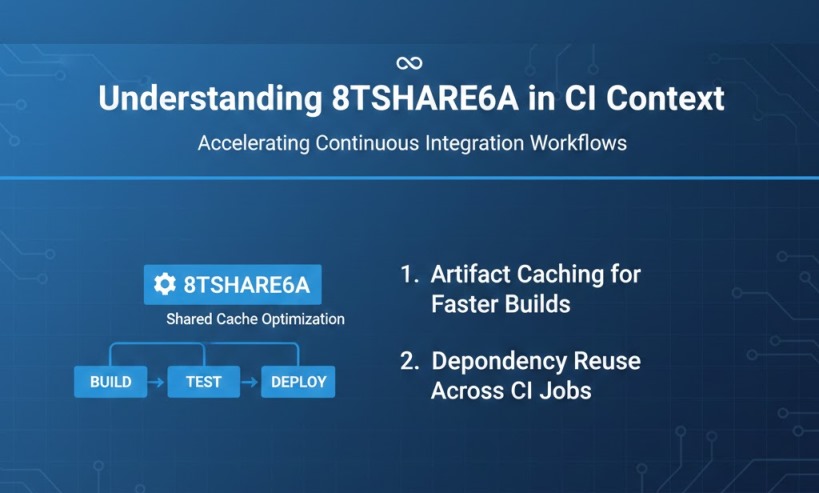
Treat 8tshare6a as a critical artifact that must be fetched, verified, and distributed consistently in every build. In a typical CI CD pipeline, this step often appears early: after code checkout and before tests or packaging.
To keep this stage from becoming a bottleneck, you need to think in terms of:
- Determinism – Every run should fetch the same version given the same commit or tag.
- Resilience – If the primary download source is degraded, the pipeline should transparently fail over.
- Observability – You must be able to see latency, error rates, and bandwidth usage per job.
Once 8tshare6a is modeled as a first-class dependency in your continuous integration pipeline, you can optimize around it with caching, mirrors, and smart versioning strategies.
Also Read: Playing Games on Blog Playbattlesquare: How It Works
Designing a high-throughput architecture around 8tshare6a
High throughput is all about running many builds in parallel without overwhelming your infrastructure or your download source. At a high level, an optimized architecture for 8tshare6a includes:
1. Localized artifact caching
Instead of having every job pull 8tshare6a from the internet or a central server, introduce a regional cache or edge node close to your runners. A well-tuned software artifact repository (for example, using Nexus, Artifactory, or a cloud-native alternative) can dramatically reduce latency and external bandwidth.
2. Horizontal scaling of runners
Use lightweight, ephemeral runners (VMs or containers) that can be scaled out aggressively at peak times. This matters most when you enable parallel builds, because each worker will need 8tshare6a available locally very quickly.
3. Network-aware download strategy
To avoid saturating your internal network:
- Throttle concurrent external downloads while allowing internal cache hits to run at full speed.
- Use HTTP/2 or gRPC where possible to reduce connection overhead.
- Prefer compressed distributions of 8tshare6a to minimize payload size.
When these components are layered correctly, you end up with a high throughput deployment pattern that can support many commits per minute without queueing or timeouts.
Integrating 8tshare6a into an automated test and release flow
The goal is to make 8tshare6a a transparent, repeatable part of your automation—never a manual step.
- Version pinning and manifests
Store the exact 8tshare6a version, checksum, and source location in a manifest file versioned alongside your application code. This keeps environments reproducible and simplifies rollbacks. - Test-time validation
Before running your test suites, add a short validation step that checks the checksum or signature of the downloaded binary. This can sit inside your automated testing framework so that corrupted or tampered downloads are caught early. - Integration with orchestration and deployment
If you’re using containerized workloads, bake 8tshare6a into base images that are refreshed on a predictable cadence. This reduces per-job download pressure and prepares your images for seamless Kubernetes deployment when you promote artifacts to higher environments.
Choosing the right tools and automation patterns
High-throughput CI is not only about raw speed; it’s about the right primitives.
- Orchestrators and runners
Popular CI CD tools like Jenkins, GitHub Actions, GitLab CI, and CircleCI all support distributed runners and caching mechanisms out of the box. Your 8tshare6a integration should leverage their native cache APIs and secrets management rather than reinventing the wheel. - Infrastructure as code
Codify the entire download, caching, and validation logic using Terraform, Ansible, or similar technologies. That way, you can recreate your high-throughput setup in a new region or cloud account without drift. - DevSecOps alignment
Treat the 8tshare6a download as a security-sensitive hop. Validate checksums, apply signed releases, and log every download event so your security team can audit changes over time.
A well-structured DevOps automation strategy ensures that any change to the way you fetch or validate 8tshare6a is reviewed, tested, and version-controlled just like your application code.
Scaling from pilot to enterprise usage
Many teams start with a single-team CI setup and then gradually scale to dozens or hundreds of repositories. To keep 8tshare6a from becoming a scaling constraint:
- Start small with a dedicated, non-production project
Build a prototype pipeline that exercises the full 8tshare6a download flow, including cache warmup, validation, and artifact reuse. - Move to a shared platform model
Once you’re confident in performance characteristics, expose the 8tshare6a-aware CI templates as reusable components. This turns your design into a scalable CI CD pipeline pattern that other teams can consume without copying and pasting scripts. - Continuously profile and optimize
Monitor download times, cache hit ratios, and end-to-end build durations. When you see regressions, treat them as first-class incidents and perform postmortems focusing on network, storage, and runner saturation. - Align with release management
Work with release managers to define how new 8tshare6a versions are rolled out: which branches get them first, what grace period older versions have, and how you’ll handle emergency rollbacks.
Common pitfalls to avoid
Even well-intentioned CI setups around 8tshare6a can degrade over time. Watch out for:
- Hidden single points of failure – A lone download server without redundancy.
- Unbounded concurrency – Runners hammering external endpoints because throttling was never configured.
- Silent cache poisoning – Artifacts cached with incorrect versions or signatures due to missing validation.
- No feedback loop – Metrics exist, but nobody is on the hook to react when download latency spikes.
Building a culture where pipeline performance is regularly inspected is just as important as the technical design itself.
Conclusion
A reliable, high-throughput CI deployment around the 8tshare6a software download doesn’t happen by accident. It requires deliberate architecture choices—caching, horizontal scaling, validation, and observability—combined with strong automation and security practices. When you treat 8tshare6a as a first-class artifact in your CI ecosystem, you unlock faster feedback, fewer failed builds, and a smoother path from commit to production.
FAQs
Q1. How often should I update the 8tshare6a version used in my pipelines?
Aim to update on a predictable cadence (for example, monthly or per-release), after validating the new version in a staging pipeline with representative workloads.
Q2. Can I share a single 8tshare6a cache across multiple teams?
Yes, as long as you enforce strict versioning and checksum validation so that one team’s changes cannot silently affect others.
Q3. What metrics should I track to ensure the download step stays healthy?
Track average and p95 download time, error rate, cache hit ratio, and total bandwidth per pipeline, and alert on deviations from your baseline.
Q4. Is it better to bake 8tshare6a into images or download it at runtime?
For very high throughput scenarios, baking it into frequently refreshed base images usually offers more predictable performance than downloading on every run.
Q5. How do I safely roll back if a new 8tshare6a version causes failures?
Keep previous versions and manifests available, and maintain a simple pipeline switch (such as a configuration flag or environment variable) that lets you revert to the last known-good version without changing code.