
Digital infusing aggr8tech is quickly becoming a practical way to talk about modern automation: instead of replacing everything at once, teams embed digital tools, data, and AI into the work they already do. That “infusion” model matters because many companies are using AI somewhere, but far fewer have truly scaled it across operations. McKinsey reports broad AI adoption at the function level, while many organizations are still piloting rather than scaling. This is exactly where digital infusing aggr8tech fits: it helps businesses move from scattered tools to a connected automation core.
- What Is Aggr8Tech and Why Every Digital Leader Is Watching It
- The Intelligent Automation Core: How It Actually Works
- 5 Ways Digital Infusion Is Rewriting the Automation Playbook
- From Manual Chaos to Smart Workflows — The Real Shift
- Inside the Tech Stack Powering Aggr8Tech’s Automation Engine
- ROI Breakdown: What Businesses Gain After Going Live
- Common Pitfalls That Kill Automation Projects (And How Aggr8Tech Avoids Them)
- Real-World Use Cases That Prove Intelligent Automation Delivers
- What’s Next: The Future Roadmap for Aggr8Tech’s Digital Core
- Conclusion
- FAQs
- What does digital infusing aggr8tech mean in simple terms?
- How is digital infusing aggr8tech different from traditional digital transformation?
- What technologies are used in digital infusing aggr8tech?
- How fast can businesses see ROI from digital infusing aggr8tech?
- What is the biggest mistake companies make with digital infusing aggr8tech?
What Is Aggr8Tech and Why Every Digital Leader Is Watching It
At its core, digital infusing aggr8tech describes a modular, business-first automation approach. Public explanations of the term consistently frame it as gradually embedding digital tools, data, and automation into everyday processes instead of running a single disruptive transformation program.
Why leaders are paying attention is simple: digital infusing aggr8tech aligns better with how change really happens inside companies. Teams can start with a high-friction process, prove value fast, then expand. That reduces resistance, lowers upfront risk, and makes adoption easier for non-technical teams—another theme highlighted in current descriptions of digital infusing aggr8tech.
The Intelligent Automation Core: How It Actually Works

The “intelligent automation core” in digital infusing aggr8tech is usually a stack of three working layers:
- AI for decisions and predictions
- Workflow/BPM for process orchestration
- RPA for repetitive task execution
IBM defines intelligent automation similarly as the combination of AI, business process management, and robotic process automation to streamline and scale decision-making.
In a digital infusing aggr8tech setup, these layers are not deployed as isolated tools. They are connected to business rules, approvals, dashboards, and security controls so work can move end-to-end. That is what turns automation from a task script into an operating model.
5 Ways Digital Infusion Is Rewriting the Automation Playbook
1) It starts with workflows, not tools
Digital infusing aggr8tech prioritizes real process bottlenecks first, then applies technology. That keeps automation tied to outcomes.
2) It favors modular rollout
Instead of “big bang” transformation, digital infusing aggr8tech improves one process at a time and scales what works. This incremental approach is one reason it feels more practical for SMBs and enterprises alike.
3) It supports end-to-end automation
Deloitte’s intelligent automation research shows mature programs move beyond task automation toward end-to-end process redesign. Digital infusing aggr8tech follows the same principle.
4) It blends humans and automation
Digital infusing aggr8tech is strongest when teams keep human oversight for exceptions while automating repetitive decisions and handoffs.
5) It compounds value over time
Each successful automation creates cleaner data, better process visibility, and stronger governance for the next one—so digital infusing aggr8tech improves momentum, not just one KPI.
From Manual Chaos to Smart Workflows — The Real Shift
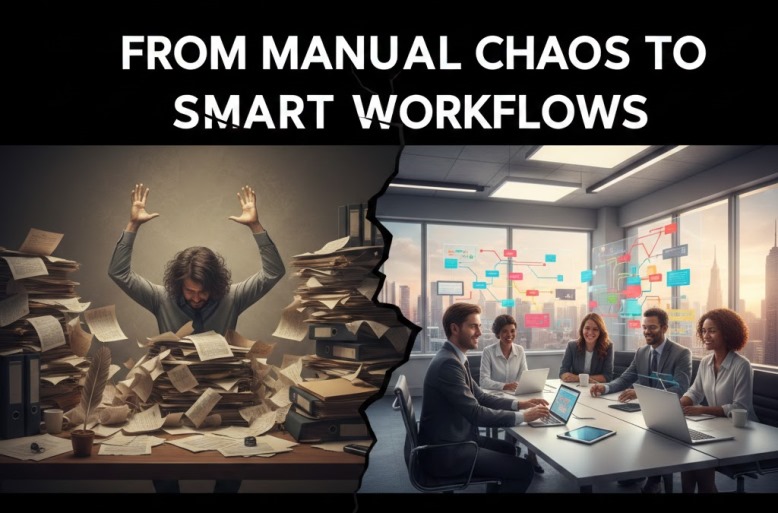
The real promise of digital infusing aggr8tech is not “more bots.” It is fewer delays, fewer handoff errors, and clearer accountability.
IBM notes intelligent automation helps simplify processes, improve efficiencies, and reduce human error in repetitive work. Deloitte also highlights common goals like productivity, cost reduction, improved accuracy, and customer experience. That combination explains why digital infusing aggr8tech resonates: it solves operational friction, not just IT complexity.
In practical terms, digital infusing aggr8tech shifts teams from inbox-driven work to rule-based workflows with alerts, approvals, and audit trails.
Inside the Tech Stack Powering Aggr8Tech’s Automation Engine
A strong digital infusing aggr8tech implementation usually includes:
- Process mapping / process mining to find bottlenecks
- BPM or workflow engine to route tasks and approvals
- RPA bots for repetitive data entry and system actions
- AI/ML models or LLM layers for classification, extraction, and recommendations
- Data layer + dashboards for visibility and KPI tracking
- Governance/security controls for compliance and access management
This mirrors how mature automation programs are evolving. Deloitte reports growing interest in broader toolkits, including AI and process mining—not just RPA alone.
ROI Breakdown: What Businesses Gain After Going Live

Digital infusing aggr8tech is attractive because the ROI story is operational, measurable, and usually visible early.
Deloitte’s survey found organizations expected an average 31% cost reduction over three years from intelligent automation, and more mature adopters reported similar realized gains. IBM also highlights measurable automation value in IT operations, including reductions in downtime costs in its automation-focused research summary.
Typical gains from digital infusing aggr8tech include:
- Faster cycle times
- Lower processing cost per task
- Better accuracy and compliance
- Improved customer response times
- Higher team capacity without linear hiring
That said, digital infusing aggr8tech performs best when companies track baseline metrics before rollout. Without baseline data, even good automation outcomes are hard to prove.
Common Pitfalls That Kill Automation Projects (And How Aggr8Tech Avoids Them)
Many automation projects fail because they automate fragments, not processes. Deloitte flags recurring barriers such as process fragmentation, lack of clear vision, IT readiness gaps, and resistance to change.
Digital infusing aggr8tech avoids these traps by design:
- Fragmentation: focuses on workflow-level redesign, not isolated scripts
- No strategy: starts with a clear business use case and expansion path
- IT disconnect: includes IT early for architecture and governance
- Change resistance: improves daily work first, so teams see value quickly
This is why digital infusing aggr8tech often feels easier to scale than traditional top-down transformation.
Real-World Use Cases That Prove Intelligent Automation Delivers
Digital infusing aggr8tech works especially well in operations-heavy teams:
- Finance ops: invoice routing, approvals, reconciliations
- Customer support: ticket triage, knowledge retrieval, escalation
- HR ops: onboarding workflows, document collection, access provisioning
- IT service management: incident classification and response workflows
- Supply chain: exception alerts, order updates, vendor coordination
These use cases align with where organizations already report high AI and automation activity—especially IT, customer-facing workflows, and knowledge-heavy processes. The strength of digital infusing aggr8tech is that it can start in one function and expand across many.
What’s Next: The Future Roadmap for Aggr8Tech’s Digital Core
The next phase of digital infusing aggr8tech will likely center on agentic workflows: systems that do more than automate single steps and can manage multi-step work with human oversight. McKinsey’s latest survey shows organizations are already experimenting with AI agents, though scaled deployment is still early.
That means digital infusing aggr8tech is moving toward:
- More autonomous workflow orchestration
- Better process intelligence from live data
- Stronger governance for AI-driven decisions
- Human-in-the-loop controls for exceptions and risk
In short, digital infusing aggr8tech is evolving from “smart automation” into a true digital operating layer.
Conclusion
Digital infusing aggr8tech is not just another automation buzzword. It is a practical model for building an intelligent automation core that improves workflows step by step, proves value early, and scales without chaos. By combining AI, BPM, and RPA inside a business-first rollout strategy, digital infusing aggr8tech helps organizations move from experimentation to real operational impact. For teams trying to modernize without disruption, digital infusing aggr8tech is one of the clearest paths forward.
Also Read: B01n4lg0tu: Complete Guide to What You Must Know
FAQs
What does digital infusing aggr8tech mean in simple terms?
Digital infusing aggr8tech means adding digital tools, data, and automation into everyday business processes in a gradual, practical way. The goal is to improve how work happens without forcing a massive one-time transformation.
How is digital infusing aggr8tech different from traditional digital transformation?
Traditional transformation is often large, phased, and disruptive. Digital infusing aggr8tech is more modular, focusing on smaller workflow improvements that deliver immediate value and scale over time.
What technologies are used in digital infusing aggr8tech?
Most digital infusing aggr8tech implementations use a mix of AI, BPM/workflow automation, and RPA, often supported by analytics and governance controls. IBM describes this combination as the core of intelligent automation.
How fast can businesses see ROI from digital infusing aggr8tech?
Results often appear faster than large transformation programs because the rollout is narrower and outcome-focused. ROI timing depends on the process, but organizations typically see early gains in speed, accuracy, and workload reduction.
What is the biggest mistake companies make with digital infusing aggr8tech?
The biggest mistake is automating isolated tasks without fixing the end-to-end workflow. Programs scale better when they include process design, IT readiness, and change management from the start.