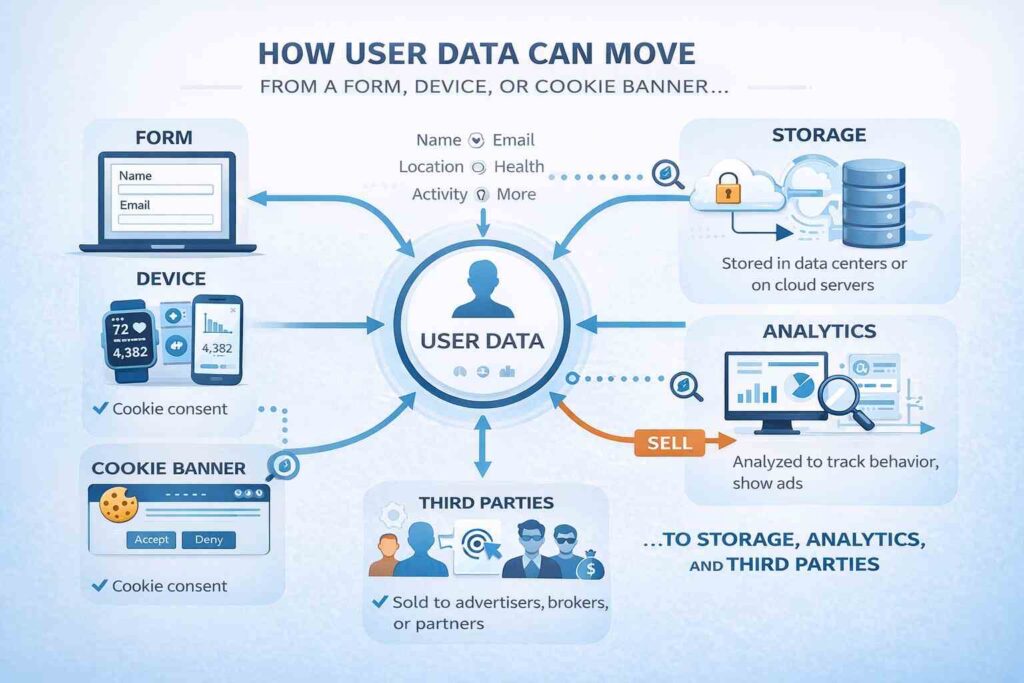
A website can talk about innovation all day, but the moment it touches bodies, sensors, or wellness, privacy becomes personal. That is why the IOFBodies.com Privacy matters: readers want to know whether a site discussing body-connected technology treats their data with the same seriousness it gives the topic itself.
IOFBodies.com describes itself as a resource about the Internet of Bodies, with sections on applications, technology, and “Ethics and Privacy.” Its homepage also says the content is for general informational and educational purposes, and its contact page lists a public email. In the pages publicly available through search and page review, I did not find a clearly surfaced standalone privacy-policy page.
This disparity is significant since privacy has evolved beyond being a mere afterthought. Pew found that 35% of Americans are very concerned and 46% are somewhat concerned about how companies use the data they collect.
Why IOFBodies.com Privacy matters
When people search for IOFBodies.com Privacy, they are usually not hunting for legal language. They want plain answers: what data is collected, why it is collected, who sees it, and what control they have.
That is also how major privacy frameworks think. The European Commission says personal data should be handled lawfully, fairly, transparently, and for specific purposes. In the U.S., HIPAA protects health information in certain settings, but it does not automatically apply to every health or wellness website. The FTC also oversees health privacy rules for some personal health record vendors and related entities.
What users should look for first
From the public pages reviewed, IOFBodies.com appears to function mainly as an educational publishing site. It emphasizes ethics and privacy as part of its subject matter and includes a broad disclaimer that the content is not medical, legal, or professional advice.
Still, the IOFBodies.com Privacy should be judged by practical checkpoints, not branding alone.
| What to check | Why it matters |
|---|---|
| Data collected | Shows whether the site asks for only basic details or more |
| Data sharing | Reveals whether advertisers, analytics tools, or partners get access |
| Retention period | Tells users how long information may remain stored |
| User rights | Covers access, deletion, correction, and opt-out choices |
| Contact method | Gives users a route for privacy questions |
If IOFBodies.com Privacy makes these points clear in plain English, trust grows. If the wording is vague or hard to find, that is a signal to be careful.

Red flags and green flags
Green flags in IOFBodies.com Privacy review
A strong privacy experience usually includes:
- A dedicated privacy page
- Clear explanations of cookies and analytics
- A contact channel for requests
- Specific retention timelines
- User rights explained without jargon
These are closely aligned with privacy principles like transparency and purpose limitation.
Red flags users should notice
Here is where concern starts to creep in:
- No obvious privacy-policy link
- Broad statements about sharing data with “partners”
- No deletion process
- No explanation of tracking tools
- No update date on the policy
For a topic so closely tied to the body and health-adjacent technology, those gaps can feel unsettling fast.
Conclusion
The smartest way to read IOFBodies.com Privacy is as a trust check. IOFBodies.com publicly presents itself as an educational Internet of Bodies resource and openly highlights ethics and privacy, which is a positive sign. But readers should still verify the basics: what is collected, why, how long it is kept, and what rights users have. In a space where technology gets very close to the body, careful reading is not overthinking. It is common sense.
FAQs
What is the IOFBodies.com Privacy?
It refers to how IOFBodies.com may collect, use, store, and protect visitor information on a site focused on Internet of Bodies topics.
Is there a clearly visible privacy-policy page?
In the publicly accessible pages reviewed, I did not find a clearly surfaced standalone privacy-policy page.
Does HIPAA automatically apply to the IOFBodies.com Privacy?
No. HIPAA applies to covered entities and certain business associates, not every website that discusses health or wellness.
Why does privacy matter so much here?
Because Internet of Bodies content sits close to biometric, behavioral, and health-related information, even when a site is mainly educational.
What should users check first?
Start with collection, sharing, retention, and deletion rights. Those four points reveal most privacy risks.
Is a public contact email enough?
It helps, and IOFBodies.com does list one, but contact details are not a substitute for a full privacy policy.